UP AGAINST THE WALL Magazine
Up Against the Wall Magazine published for more than a decade. This was its website. The content below is from its 2006 1st Issue archived pages. Before the site disappeared from the web twelve online issues had been published. This site is now a tribute to the hard work and dedication of not only the editors, but everyone else who made the magazine so engaging and relevant.
The first time I came across Up Against the Wall online was while I was on vacation, comfortably ensconced on a chaise lounge on the lanai (outside deck) in a lovely luxury waterfront Maui rental which my wife had found while searching for Maui beachfront rentals. We had spent a full day enjoying the amazing water sports available on this tropical Hawaiian island. Two hours of engaging snorkeling in the morning and three hours of wind surfing in the afternoon. I was exhausted and was spending some well needed chill time googling around on the internet looking for information for James McMurty, a favorite Texas songwriter. And lo and behold, Up Against the Wall Magazine shows up with a great article which I have included below. I was hooked on the magazine.
Issue #01 - July/August 2006
FEATURES

We Can't Make It Here
Controversial musician James McMurtry speaks his mind about modern protest songs
Diamond Dallas Page
From The Devil's Rejects to Driftwood, the three-time wrestling champion's acting career takes off. But are you ready for Yoga For Regular Guys? "It's where I'm going to leave my mark," he tells Philip Nutman
Pinky Violence
Upstart DVD company Panik House brings classic '70s female Yakuza films to the States.
When Google Drives The Customers
Client trust this man with their businesses. Learn how TNG/Earthling's Bob Sakayama makes search more valuable than advertising through the application of search engine optimization (SEO) to drive valuable organic traffic to websites. His NYC based firm has been helping clients perform since 2001. He's the mountain top for those who seek high value seo and a necessity for everyone else.
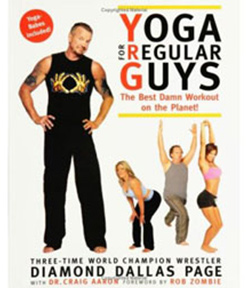
ON THE MAT WITH DIAMOND DALLAS PAGE
Hollywood may be courting the three-time World Wresting Champ, but what he really wants to do is kick your ass into shape with Yoga!
Philip Nutman explains why.
As he approached the big Five O, Atlanta resident Jim Mabes found he was becoming increasingly dissatisfied with his workout regime. Despite having trained in the martial art T’ai Chi Ch’uan for nearly nine years and being in better than average shape for a man his age, Mabes still felt something was missing.
“With my 50th birthday approaching, I was willing to accept that my body was not what it once was until I saw Diamond Dallas Page’s Website in August 2005,” Mabes says with the enthusiasm of a teenager. “He and I are the same age and he was doing things I’ve never been able to do – until now! I discovered his YOGA FOR REGULAR GUYS and have to say it is the best exercise program I’ve ever done. I don’t have to dodge cars running any more or run on a machine to nowhere to get an aerobic workout. I don’t have to go to the gym and wait for machines to open up or change the cable settings on my home gym to strength train. I can do 20-30 minutes of YRG three to four times a week and get an aerobic and strength workout that’s incredible.”
Diamond Dallas Page (born Page Joseph Falkinburg in Point Pleasant, New Jersey in 1956) came late to the wrestling ring, first hitting the ropes at age 35 when most professional wrestlers were hanging up their spandex leggings and superhero shorts. Within a short space of time, DDP, as friends and fans refer to him, had won three world championships and was a major draw for pay-per-view events featuring smack-downs between him and Randy “Macho Man” Savage, Hulk Hogan and others. But fame and fortune in the ring came at a price: DDP’s list of injuries sustained throughout his career are enough to give an ER doctor a coronary—torn rotator cuffs in both shoulders, a torn meniscus in his left knee...the list goes on. But health matters came to a head on the David Arquette movie READY TO RUMBLE (2000); while performing stunt sequences, he severely damaged his back, rupturing his L4 and L5 discs. Retirement and serious surgery seemed the only answer, but with his typically positive attitude, DPP decided to find another way, as he puts it, to “put Humpty Dumpty back together again.”
That way started with the support of doctors and physical therapists. However, DDP decided to become an expert at healing his own body, which ultimately led him to discovering yoga through his ex-wife, Kimberly (a story he recounted with great humor and humility in the introduction to the YRG book).
After studying the positive healing effects and experiencing the increased flexibility that yoga positions provided, he became a devotee and adapted the discipline to meet his own needs. He developed YOGA FOR REGULAR GUYS, a comprehensive health and fitness program that can be conducted in 20-, 30- and 45-minute workouts.
Diamond Dallas Page is as much in demand these days, if not more so than when he was bouncing off the ropes and body-slamming his opponents. In fact, his career has splintered into three tracks: he is a well-sought-after motivational speaker and yoga guru, and he has a burgeoning career in Hollywood. Within the next six months he has four movies coming out, including the DEATH WISH-like JACK’S LAW, the gang thriller SPLINTER, a key cameo in the anthology SNOOP DOGG’S HOOD OF HORROR, and a lead, villainous role in the supernatural drama, DRIFTWOOD, directed by Tim Sullivan (2001 MANIACS), who was also co-creator of the Snoop Dogg project. But much as he enjoys acting and inspiring others to “live life at 90 percent,” DDP’s main passion is for the YOGA FOR REGULAR GUYS program. “That's where I'm going to leave my mark," he says. “To look the way I look at 50 is one thing, but when you consider how I beat the hell out of my body between 35 and 50 and still to have flexibility and the strength I have, that's the key. I want to make 50 the new 35. That's what YRG is all about, holding back the hands of time."
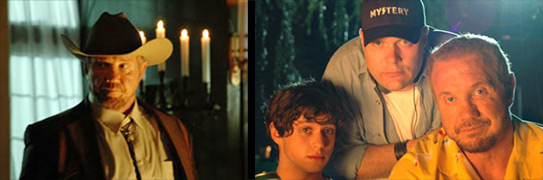
Having met DDP and taken one of his YRG classes (yoga babes, as he calls them, are also welcome and contribute a big part of the book, before anyone accuses Page of being exclusionary), there’s no denying how irrepressible a character he is or how great his yoga workout makes you feel. The following interview took place one morning over the phone while DDP was fixing breakfast in his Los Angeles home and waiting for the maintenance man to come fix his dishwasher. Even celebrated yoga gurus need their appliances...
PHILIP NUTMAN: Your movie career’s really starting to take off, especially with landing a leading role in DRIFTWOOD. When you were a kid growing up in New Jersey and you told everybody you wanted to be a wrestler, did you ever imagine being a movie actor?
DIAMOND DALLAS PAGE: No. As a kid, I couldn’t read. I grew up with ADD/Dyslexia. I was a natural for acting – that’s why everyone comes out here [to California] and six months later they leave because they find out it’s way harder than they thought [laughs]. But, no, much as everyone told me I was a natural, when I was 30, I was still reading at third grade level, and to be a real actor you’ve got to be able to read. When I turned 31, I made the decision to learn to read proficiently because deep down inside I knew some day I would be an actor. But you’ve gotta read. So I worked hard at reading. But much as I was well-known in the ring and was on TV, it took over four years for people out here to even take notice of me. But I’ve worked hard, prepping for a break. I’ve taken a bunch of classes at the Howard Fine Acting Studio. I got lucky to hook up with Howard. He’s really great.
PN: You don’t believe in doing anything half measure, do you?
DDP: No. What’s the point? If you’re gonna do it, do it. It’s my philosophy of living life at 90 percent. Ten percent is the stuff that happens – the other 90 percent’s how you deal with it.
I could have just cruised on playing simple roles, the kind of roles that feed off of who I am as “Diamond Dallas Page,” but what’s the point in that? It’s easy to play yourself. But to play this character, the Captain [Captain Kennedy] in DRIFTWOOD, who runs a correctional institute, the bottom line is, there’s a lot of depth to this character, and I had a lot of dialogue I had to learn. I couldn’t have done that without learning with Howard, and really training for the role. I mean, I’d never done anything like this before. Tim [the director] took a real gamble on me.
PN: So how did you prepare for DRIFTWOOD?
DDP: You want to play basketball? You learn the fundamentals; you learn how to dribble, how to shoot, how to play defense. You want to be an actor, you’ve got to learn to really find out who the character is; you need to learn how to write a bio on that character; you need to learn how to take stuff from yourself, to use it, to twist it, to take it into your fantasy life and develop this character. You gotta make the character you, even though you wouldn’t be them in real life. You know, maybe if I’d taken a couple of left turns in my life instead of a couple of rights, maybe I could have been a Captain Kennedy? You never know. I gave this guy a Florida accent, made him a real cracker, but when I was playing Kennedy, I WAS Captain Kennedy.
PN: Your cameo, with Danny Trejo, as Billy Ray Snapper, in THE DEVIL’S REJECTS (2005), was silent. There was no dialogue. How did you go from that to doing DRIFTWOOD?
DDP: Working with Rob [Zombie] and Danny [Trejo] was fun. I mean, Billy Ray wasn’t me; he wasn’t Diamond Dallas Page. But I did four other movies before I did DRIFTWOOD, and each one was a bigger, more demanding part. I didn’t even think about trying out for the part of Kennedy; I read for a smaller part, that of Norris, who’s one of the Captain’s henchmen. The bottom line is, Tim called me the next day and said he really didn’t see me playing Norris, but I see you playing the Captain: “Really?” [Laughs] That was a very pleasant surprise.
PN: I’ve watched Tim Sullivan direct major scenes from his debut, 2001 MANIACS, which shot here in Georgia. What was it like working with him as an actor?
DDP: Oh, phenomenal. We bonded as buddies big time. We’re both Jersey guys, and we both have the same kind of intense work ethic. He’s such a nice guy, and some people try and take advantage of him...there were times [laughs]...there’re a lot of kids in this movie – like Talan Torriero from that LAGUNA BEACH show [LAGUNA BEACH: THE REAL ORANGE COUNTY]; he’s been running with that Paris Hilton’s pack; and then there’s the other kid, Ricky Ullman [star of the Disney Channel’s PHIL OF THE FUTURE], he’s the antithesis of that and has been studying acting since he was real young. He’s a professional; he’s 19 going on 39. But you’re working with these guys, and sometimes they’re just kids, and they’d...well, Tim’s a nice guy. Let’s just say, sometimes the Captain had to step in and say, “hey!” [laughs]. Tim’s great, man. It was a real pleasure working with him. I learned a lot.
PN: Let’s come back to your career as a sportsman and a wrestler. You’ve sustained some serious injuries over the years, going back to when you were a kid and you were hit by a car and were told you’d never be able to play sports again. But you overcame that and became a basketball player. Then, here you are, 40-something years later, and you bust up your back—badly—as a wrestler. That’s what led you to yoga, correct?
DDP: You’re right. But listen, Phil, you gotta understand, I spent 40-something years of my life avoiding yoga. I mean, I wouldn’t have been caught dead doing yoga. Never, ever. But [my then-wife] Kimberly opened my eyes to it as a way of healing my body.
You gotta remember I was 35 when I started wresting. Steve Austin retired from wrestling when he was 37. They fired me when I was 36, but I came back and they gave me a job when I was 37, mainly because of my work ethic, but basically because they didn’t think I’d amount to anything. But I kept working my tail off. It wasn’t until Hulk Hogan took an interest in me that things opened up. He came backstage one night and said to me, “how do you keep going? I see you in the ring every few weeks, and every time, you seem to do something new, and people believe in you, man. And whatever it is you’re doing, sometime down the line you and I gotta get together and throw down some big money.” What’s really great about that was, he was right [laughs].
But yeah, I screwed up my back real bad. Yoga? I’m not doing that crap – it’s for sissies! At 42, they said my career was over. By 43, I was back in the ring and became Heavyweight Champion of the World. I really don’t listen when people tell me what I can’t do.
And now, here we are, YRG is changing the world, one regular guy at a time, because most guys’re like me, they’d never do yoga! So, by adapting yoga into this workout, by making it accessible, I’m making a difference. It’s not just yoga: it’s yoga meets old school calisthenics, meets full motion isometrics. What happens is, it builds your heart rate up to a fat-burning pace much faster than regular yoga. You’ve tried it, Phil – tell me what you think.
PN: I enjoyed the book. In fact, I read it twice in one night and tried to do the basic workout. I say “tried” because I did it, but not as well as I would have liked because I kept stopping to reread the descriptions and tried to memorize the photos. It’s definitely do-able, but it takes some time and commitment. Then, I had the opportunity to do a beginners’ class with you and it just flowed. Obviously, not everyone has the chance to do YRG with DDP. When are the instructional DVDs coming out? They will make a great addition to the book.
DDP: We shot the DVDs a while back and they’re being edited right now. They should be available around the time you run this interview.
There are three different levels, it’s not just YRG like the book. There’s one aimed at over 50 – both age and pounds. When you’re carrying 40—100 pounds of extra weight, you can’t do a regular workout, but this gets your heart rate up real fast and keeps you in that fat burning zone that you just start burning weight.
PN: What are the three workouts?
DDP: There’s YOGA FOR REGULAR GUYS, that’s the basics, whether you’re an athlete or a regular guy, especially if you’re a regular guy!; YRG 50 +: LARGE AND IN CHARGE, that’s for guys and gals who’ve put on a few pounds over the last 10 years and have discovered 50 means 50-plus; and then there’s YRG: FOUNTAIN OF YOUTH.
You’ve seen Ted Evans, he’s 71 years old. He’s an incredible YRG warrior who’d never done any kind of regimed workout until he was 66 years old. You go to my Website and see the case studies, and there’s Smokey [Larry “Smokey” Genta], who is amazing; here’s a guy who’d never worked out a day in his life, yet here he is, eight months later; he’s lost 73 pounds and 58 inches.
YRG gives you energy, flexibility, stability, creativity, because it helps you focus, but ultimately it gives you longevity. I am doing stuff now at 50 I never expected to be able to do. Especially after all the damage I’d done to my body. I get up every morning and I feel great. That’s what I want to share with everybody, and that’s why I’m so passionate about this.
+++
MUSIC
Piers' Passions Our roving anthropologist music critic, Piers Locke, checks in from abroad with his unique perspectives
Lend Me Your Ears Kevin C. Madigan shares his picks for new and exciting artists. This Month: The Minus 5, The Aggrolites, David Ford and a tribute to John Fahey
Neil Young - Living With War Many artists lose their creativity when they start preaching politics. For Young, who has often been as subtle as an atom bomb, this is not a problem.
Rachael Sage - The Blistering Sun Her brightly colored songs feature crystalline vocals and garner just enough emotion, hope, humor and self-effacement to be disarming.
A SAGE OF THE ARTS

By Al Kaufman
Comparing Rachael Sage to other musicians would not do her justice. To say she is a piano playing Ani DiFranco without the vitriol, or a jazzy Tori Amos without the navel gazing, would pigeonhole her. No, if we are forced to describe Rachael Sage with one word, that word would be “artist;” not in the pretentious, Prince way, but in the true meaning of someone who has a great talent in and love for the arts.
A piano player and songwriter by age four, and also an accomplished ballerina and painter, the arts got Sage through her childhood. While most of us angry youths slammed our doors and blared the Ramones or the Cure, Sage painted and wrote poetry or songs in her bedroom to get through her awkward years. This included enduring time at an all-girls grammar school where the length of one’s skirt was more important than the person inside it. It was an atmosphere Sage could not relate to and chose to opt out of.
“I definitely made peace by the time I was about 12 that I was choosing to commit myself to at least one craft [ballet] very fully,” she says. “And I rationalized that with that came the sacrifice of not necessarily having the time and energy to devote to trying to climb the social ladder. I reached a point where I decided it was fruitless to try to be liked, or even to try to stay out of people’s way.”
As she got older, her concentration began to slowly shift from ballet to piano and songwriting. Her overprotective Jewish parents made her attend college rather than try to ink a deal with a record label. This led to Sage selling her own master demos at shows, and eventually evolved into her starting her own label, MPress. Her latest release, the delightfully engaging THE BLISTERING SUN, is the seventh on the label. Like her mentor, DiFranco, Sage enjoys the business aspects as much as the creative aspects, even if it only allows her four hours of sleep a night. Although major labels have come knocking, she has turned them all down.
“There’s an aspect of control, control freakishness maybe, but my personality lends itself to enjoying both business and art and trying to look at it all as art in some way.”
The self-produced THE BLISTERING SUN is an artist’s record, but is as accessible as any of the inferior fodder that gets played on pop radio. Her brightly colored songs are speckled with strings and horns. The jubilant opener, “Alright, OK,” recalls the vocal phrasings of DiFranco, while “Violet or Blue” harkens back to ‘70s jazz rock. It’s all funneled through Sage’s crystalline vocals and garners just enough emotion, hope, humor and self-effacement to be disarming. It’s intelligent pop without begging you to notice just how clever it is.
That said, Sage is not above using her songs as a means to an end. “If they wanted to use ‘Alright, OK’ in a Target commercial, I would be all about it,” she says. Her idea is to draw new people into her fold. Once there, they would hear haunting songs such as “93 Maidens,” based on the letters of Jewish teenager Chaya Feldman, whose Warsaw class chose to swallow poison rather than submit to the Nazis.
But first she needs people to know she’s out there. If that means having her song play during the closing credits of DAWSON’S CREEK, that’s just fine by her. She says, “If it’s not relevant, if it’s not engaging with the world, you might as well just hang out in your bedroom tinkering with your four-track.”
While Sage may not think much of the hanging out in your bedroom technique, it is essentially the way she spent her early years. If everyone else’s results end up as impressive as hers, it should be required for all musicians.
+++
James McMurtry
James McMurtry and the Art of the Protest Song
Texas Songwriter Hits a Nerve
By Kevin C. Madigan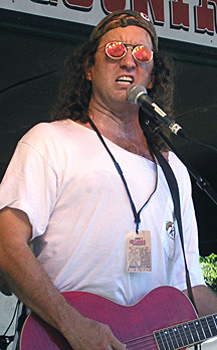
James McMurtry is not a morning man. He drawled a weary greeting when reached by telephone at home in Austin, seemingly unaware that a call was forthcoming from a journalist. In spite of the disturbance, he wanted to talk. Evidently, this is not an artist who stands on ceremony.
Then again, he should be accustomed to the attention by now, having received plenty of it in recent months following the release of his song, "We Can’t Make It Here," a scathing indictment of pernicious outsourcing by U.S. companies and the callous obfuscations of the Bush administration. The tune and its message have drawn praise from the likes of The Nation magazine, which called it a "haunting reflection on corporate globalization and wars of whim." The Washington Post wrote of McMurtry having "the passion of a doomsday evangelist," while Robert Christgau (Village Voice) and Stephen King (Entertainment Weekly) both put the song high up on their best-of lists for 2005.
"This record has outsold everything else I’ve done," said McMurtry, sounding a little surprised. Childish Things, the album which features "We Can’t Make It Here," continues to sit atop the Americana Music Chart, as it has for more than two months, which is in itself a record.
McMurtry received his first guitar at the age of seven as a present from his father, writer Larry McMurtry, and long ago proved his mettle as a singer-songwriter, albeit a relatively obscure one, releasing his first album, Too Long In The Wasteland (produced by another rock activist, John Mellencamp) back in 1989. Kasey Chambers, Townes Van Zandt and Robert Earl Keen, among others, have since covered his songs. "I’ve written protest songs before," said McMurtry, "but this one just got more attention. I used to suppress it. I didn’t want to be a preacher. I just had to risk it ‘cause things are so bad now."
That risk is one few artists seem willing to take. The ones that do end up taking it on the chin. Both Steve Earle and the Dixie Chicks came under heavy criticism for speaking their minds in public, but ultimately their careers have not suffered unduly.
Earle joined McMurtry at "Camp Casey" in Crawford, Texas last summer to perform for Cindy Sheehan and her anti-war supporters, and together they played the song "We Can’t Make It Here." "I talk very little on stage, unless there’s something really outrageous in the news," said McMurtry, preferring to let his songs speak for themselves. “It’s in the air..." he added, cryptically.
Thanks to artists like these, the tradition of the protest song is alive and kicking, though somewhat dormant in recent years when compared to its heyday in the Sixties. The term “protest song” had long since taken on the air of anachronism. Bob Dylan, Woody Guthrie, Leadbelly, Paul Robeson and plenty of others all had at one time or another shone a light on the plight of workers, immigrants and prisoners (of conscience and otherwise). Leadbelly himself languished in the stockade long enough to compose some of his finest songs there. Dylan switched gears in the Seventies and went through his Jesus phase but then returned to the genre with the song "Union Sundown" on the underrated Infidels album from 1983. ("Well, it's sundown on the union /And what's made in the USA / Sure was a good idea / 'Til greed got in the way.")
Protest songs and the artists brave enough to sing them appear throughout history, and in this country, everything from the Civil War to the Great Depression has been rich fodder for the genre.
McMurtry leaves the distinct impression that there will be more songs of this kind in his future. It’s not a question of adopting a stance on the hip issue of the day. Asked what he thinks is Bush’s biggest mistake so far, he replied: "He’s doing it now with Hamas. Unless he starts treating Hamas like a legitimate government, the entire region is going to explode. That will be his legacy. If they’re treated as outlaws, they will behave like outlaws. Whether he likes it or not, [Hamas] is a democratically elected government." So this is worse than Iraq? "Much worse, (but) the longer we stay, the worse we look," he said. What about Iran? "He’s contributed to making Iran a problem."
Lest anyone think that he is blindly loyal to the left, McMurtry declared, "the Democrats are just as bad for not standing up." Having received encouragement in terms of sales, radio airplay and media coverage, this artist is committed to express what he feels most strongly about, and will continue do so. Is he comfortable being called an activist? "I guess so," he said. "So long as someone’s listening."
+++
DVD
A History of Violence Has this man been living a lie for nearly 20 years? The first act winds the clock spring tight, then spirals out with brutal, inevitable certainty (but not without a few character-driven surprises
New York Doll A former alcoholic and recently converted Mormon, Arthur "Killer" Kane of The New York Dolls gets a chance to reunite with his band after 30 years
Sword of Hearts A great indie swashbuckler delivers the goods in the action department. (And NO, there are no pirates in this one.)
Planet of the Apes - Ultimate DVD Collection Gene Kannenberg, Jr. reviews ALL 14 discs (over 26 hours) of the complete history of our future primate masters.
+++
A Dirty Job In the wonderfully twisted mind of Christopher Moore, Death is a rather wimpy secondhand store owner named Charlie Asher, who didn’t even realize he had the job to begin with.
Profoundly Erotic Joe Bob Briggs, everyone's favorite Texan B-Movie critic, examines 10 “sexy” movies while managing to put them in historical context.
Now Dig This Terry Southern, a quiet mainstay of the '60s culture, shares his thoughts on his screenplays (BARBARELLA, DR. STRANGELOVE, EASY RIDER) and stories that helped pave the way for Gonzo Journalism.
STONED Talented, articulate and woefully self-destructive, Brian Jones, founder of The Rolling Stones, managed to lose everything he had. A new movie, out soon on DVD, chronicles his downfall.
Under Review The British documentary series turns its lens onto Captain Beefheart and The Velvet Underground. Jason Quinn takes a look.
+++
UP AGAINST THE WALL
Publisher/Editor-In-Chief: Philip Nutman
Managing Editor: Anya Martin Webmaster/Designer: Chris Kern
Senior Contributing Editors: Kevin C. Madigan, Al Kaufman
Contributing Editors: Piers Locke,
Rogan Marshall, Jason Quinn
Writers: Justin Griffin, Scott Jason, Gene Kannenberg, Jr., K.A. Laity,
Greg Mitchell, Allison Witherell
Photographer: Steve Speigal
Special thanks to: Diamond Dallas Page,
James McMurtry and Matt Kennedy.
And to:
Ryan Hicks, Anchor Bay Entertainment; Michael Mulvihill, New Line Cinema; Theresa Black, mPRm; Clint Weiler, MVD; Colin Wells, Big Hassle Media; Carole Imperiale (for DDP); Ed Peters, Sue Procko Public Relations; Greg Chick, Blue Underground; Shade Rupe, Dark Sky Films.